






When buying a home, most people focus on factors like the neighborhood, school district, commute, flood zone, HOA fees, and property taxes.
One thing that's often overlooked is local parking regulations.
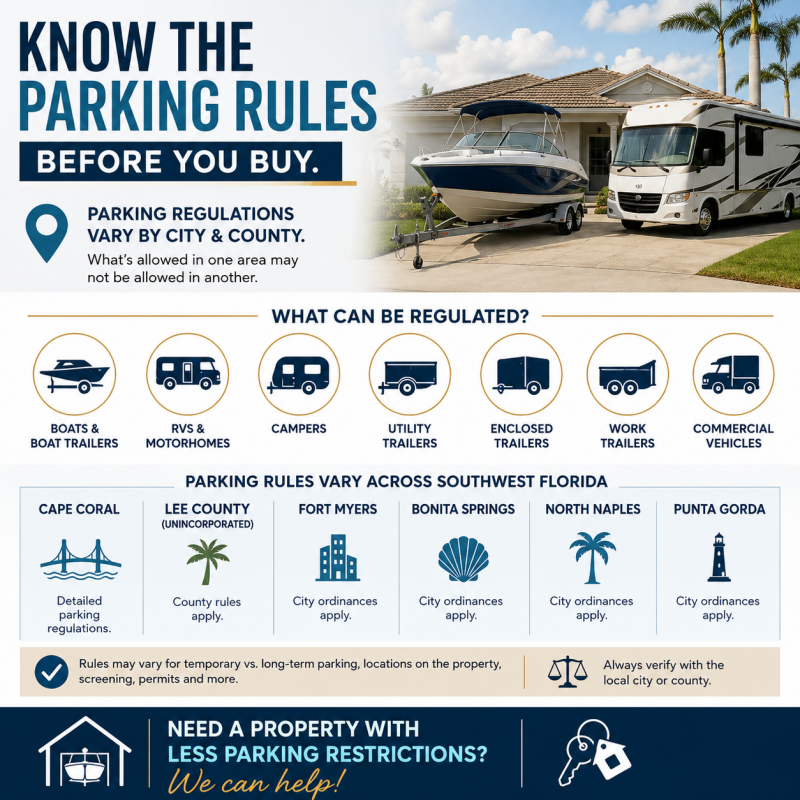
If you own a boat, RV, camper, utility trailer, enclosed trailer, work trailer, or certain commercial vehicles, where you live can have a significant impact on where—and sometimes whether—you can park those vehicles on your property.
Every Community Has Its Own Rules
One common misconception is that parking regulations are the same everywhere. In reality, they can vary considerably from one city or county to the next.
For example:
- Cape Coral has its own municipal parking and land development regulations.
- Fort Myers has its own city ordinances.
- Bonita Springs, Naples, and Punta Gorda each enforce their own municipal codes.
- Lehigh Acres, Alva, Buckingham, Gateway, and other unincorporated areas of Lee County are governed by Lee County ordinances rather than a city's code.
Because each jurisdiction adopts its own regulations, what's permitted in one community may not be permitted in another.
What Types of Vehicles Are Commonly Regulated?
Many local governments have ordinances addressing the parking or storage of vehicles such as:
- Boats and boat trailers
- RVs and motorhomes
- Campers
- Utility trailers
- Enclosed trailers
- Work trailers
- Certain commercial vehicles
The specific rules vary, but they may address:
- Where a vehicle can be parked on the property
- Whether temporary parking is allowed
- Long-term storage requirements
- Screening requirements
- Setback requirements
- Parking surface requirements
- Commercial vehicle restrictions
These regulations are typically intended to balance residential appearance, neighborhood standards, public safety, and property use.
Why This Matters
Imagine purchasing a home specifically because it has a large driveway—only to discover later that local regulations restrict how or where your boat or work trailer can be parked.
For homeowners who own recreational vehicles or operate businesses that rely on trailers, these rules can become an important part of everyday life.
Understanding them before purchasing a property can help avoid surprises after closing.
Questions Worth Asking Before You Buy
If you own any of these vehicles, consider asking:
- Can I park my boat in the driveway?
- Are utility or enclosed trailers permitted?
- Are RVs allowed to remain on the property year-round?
- Are there screening or rear-yard storage requirements?
- Are temporary permits required for loading, unloading, or maintenance?
- Does the property have an HOA with additional restrictions beyond the local ordinance?
The Bottom Line
Every buyer has different needs, and every community has different regulations.
Taking a few minutes to review local parking ordinances before purchasing a home can help ensure the property fits your lifestyle—not just today, but for years to come.
If you own a boat, RV, camper, or use a trailer for your business, parking regulations are an important part of your home search.
Looking for a property that better fits your parking needs? We'd be happy to help you find a home and community that aligns with your lifestyle while guiding you through the local considerations that matter most.